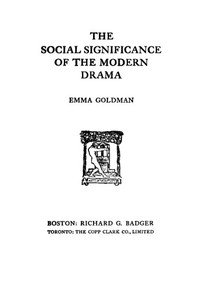
The Social Significance of the Modern Drama
by Goldman, Emma
Collection
Project Gutenberg
Project Gutenberg Release
Project Gutenberg ID
43490
Reading Ease
Reading ease score: 71.7 (7th grade). Fairly easy to read.
Rights: Public domain in the USA.
Summary
"The Social Significance of the Modern Drama" by Emma Goldman is a critical analysis written in the early 20th century. This work explores the role of modern drama as a reflection of social realities and revolutions, contrasting it with the idea of "art for art's sake." Goldman argues that contemporary writers such as Ibsen and Strindberg function as social commentators, unveiling the conflicts and injustices within society. The opening of the book sets the stage for this inquiry by establishing the premise that modern drama serves as a significant medium for understanding and advocating for social change. Goldman seeks to highlight how artists from various backgrounds use their work to reflect the broader struggles of humanity, emphasizing their potential to inspire thought and action among the public. She critiques both radical and conservative perspectives for misunderstanding the power of art, framing modern drama as a potential catalyst for societal evolution amidst political oppression. The discussion introduces key figures in the modern drama movement, establishing a foundation for analyzing their works later in the book. (This is an automatically generated summary.)
Metadata
bookshelf
Category: Essays, Letters & Speeches
Category: Plays/Films/Dramas
Category: Sociology
language_code
en
locc_code
PN
subject
European drama -- History and criticism
Drama -- Social aspects
More by Goldman, Emma
My further disillusionment in Russia
1924
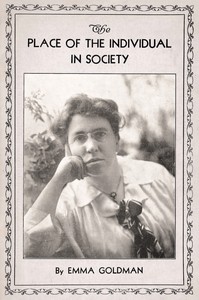
The place of the individual in society
1940
A fragment of the prison experiences of Emma Goldman and Alexander Berkman In the State Prison at Jefferson City, Mo., and the U. S. Penitentiary at Atlanta, Ga. February, 1918–October, 1919
My Disillusionment in Russia

Anarchism and Other Essays