A Treatise of Human Nature
by Hume, David
Collection
Project Gutenberg
Project Gutenberg Release
Project Gutenberg ID
4705
Reading Ease
Reading ease score: 47.0 (College-level). Difficult to read.
Rights: Public domain in the USA.
Summary
"A Treatise of Human Nature" by David Hume is a philosophical work written in the early 18th century. The book seeks to explore the underlying principles of human nature, with a focus on understanding the origin and workings of human thoughts and emotions. Hume delves into various topics of human experience, highlighting the relationship between impressions and ideas, and how these elements contribute to our understanding of reality. The opening of the treatise introduces Hume's approach, emphasizing that all perceptions in the human mind consist of two distinct types: impressions, which are vivid and forceful, and ideas, which are their fainter representations. Hume proposes to categorize these perceptions and elucidate their qualities and relationships, especially focusing on how simple ideas derive from simple impressions. He aims to establish a foundational understanding of human nature that connects ideas and their origins, while also hinting at the broader implications this understanding may have on other branches like ethics and social philosophy. (This is an automatically generated summary.)
Metadata
bookshelf
Category: Philosophy & Ethics
Philosophy
language_code
en
locc_code
B
subject
Knowledge, Theory of
More by Hume, David
An Enquiry Concerning Human Understanding
A Treatise of Human Nature Being an Attempt to Introduce the Experimental Method Into Moral Subjects; and Dialogues Concerning Natural Religion

Hume's Political Discourses
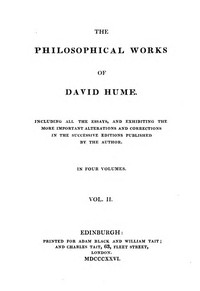
Philosophical Works, v. 2 (of 4) Including All the Essays, and Exhibiting the More Important Alterations and Corrections in the Successive Editions Published by the Author

Philosophical Works, v. 1 (of 4) Including All the Essays, and Exhibiting the More Important Alterations and Corrections in the Successive Editions Published by the Author